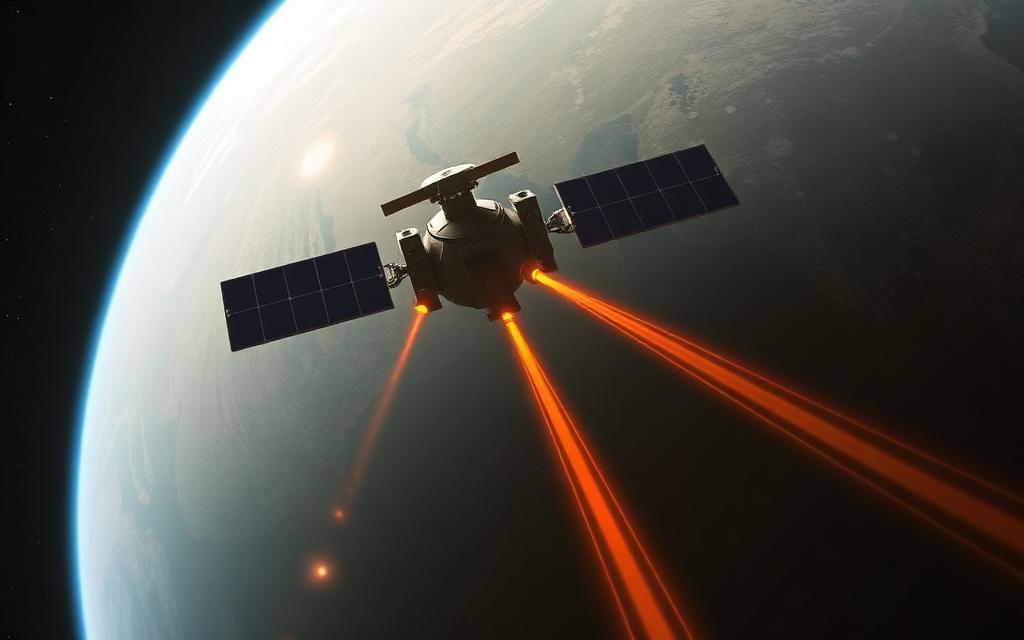
GPS — the Global Positioning System — is a constellation of about 31 active satellites operated by the U.S. Space Force. Originally a Cold-War military project, GPS now powers navigation in phones, cars, ships, airplanes, drones, agriculture, surveying and even the precise time-stamps that keep stock exchanges and mobile networks synchronized.
The Constellation
GPS satellites orbit in Medium Earth Orbit at 20,200 km altitude, in six orbital planes inclined 55° to the equator. From any spot on Earth at any time, at least four satellites are above the horizon — the minimum needed to compute a 3D fix.
Trilateration, Not Triangulation
Each satellite continuously broadcasts its position and the exact time the signal left. Your phone measures how long the signal took to arrive. Multiplied by the speed of light, that gives the distance to that satellite. With distances to four satellites you can solve for your position (X, Y, Z) and the receiver's clock error — that's trilateration.
Why Atomic Clocks Matter
Light travels 30 cm per nanosecond. To position you to within a meter, the satellite's clock must be accurate to a few nanoseconds. Each GPS satellite carries multiple cesium and rubidium atomic clocks, ground-corrected daily. Even Einstein matters: relativistic time dilation between orbiting clocks and the ground is corrected at +38 microseconds per day or your fix would drift by kilometers.
Signal Bands
- L1 (1575.42 MHz) — civilian C/A code, used by every consumer device.
- L2 (1227.60 MHz) — second civilian and military signal for ionosphere correction.
- L5 (1176.45 MHz) — newer high-precision aviation and survey signal.
Other GNSS
GPS isn't alone. Russia's GLONASS, Europe's Galileo, China's BeiDou, India's NavIC and Japan's QZSS all provide global or regional navigation. Modern phones combine signals from multiple systems for faster, more accurate fixes.
Try It
See the GPS constellation overhead on the live tracker, or read about satellite visibility coverage in your area.