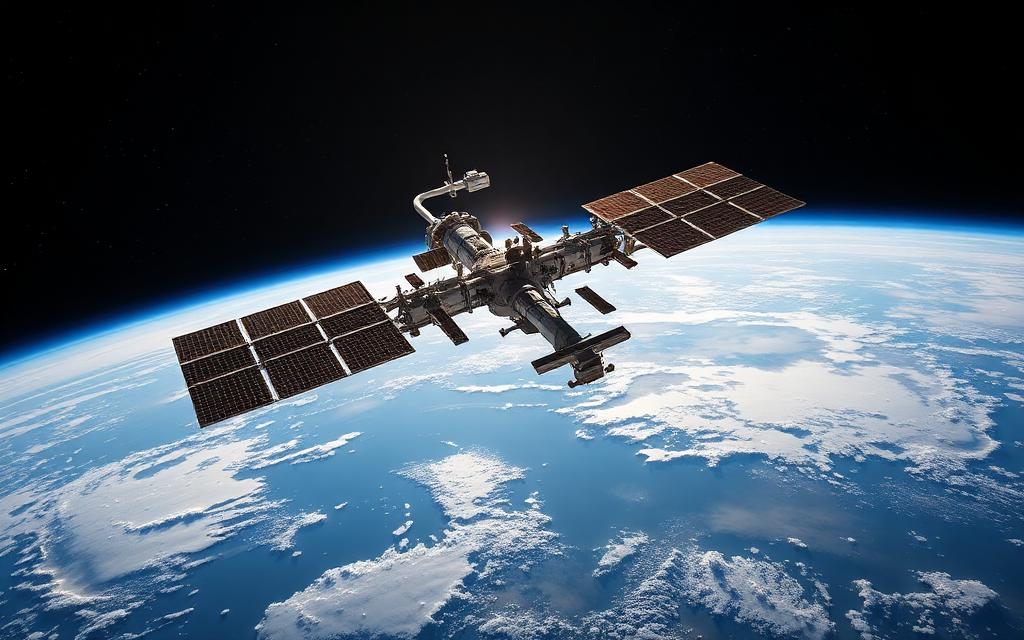
The International Space Station (ISS) is the largest crewed object ever placed in orbit. About the size of a six-bedroom house with a wingspan larger than an American football field, it has been continuously occupied by astronauts since November 2000 — the longest unbroken human presence in space in history.
ISS live HD stream
Live video feed from cameras aboard the International Space Station, courtesy of NASA. When a black screen is shown, the ISS is on the night side of Earth or a signal switch is in progress.

ISS in motion
Footage from inside and outside the station — courtesy of NASA.
Orbit and Speed
The ISS orbits at an average altitude of 408 km in Low Earth Orbit, inclined 51.6° to the equator — chosen so that rockets from both Florida and Baikonur (Kazakhstan) can reach it. It travels at 7.66 km/s and completes one orbit every 90 minutes, meaning the crew sees 16 sunrises and sunsets every day.
Modules and Construction
Built piece-by-piece between 1998 and 2011, the ISS now consists of 16 pressurized modules contributed by NASA, Roscosmos, ESA, JAXA and CSA. Highlights include the U.S. Destiny lab, Europe's Columbus, Japan's Kibo, and the seven-windowed Cupola observation dome that has produced thousands of iconic Earth photographs.
Science Onboard
- Microgravity protein crystal growth that informs new pharmaceuticals.
- Long-duration human physiology — bone loss, muscle atrophy, eyesight changes.
- Material science and combustion experiments impossible to run on Earth.
- Earth observation instruments mounted externally.
Crew and Visiting Vehicles
Typically six or seven astronauts live aboard at once. They arrive on SpaceX Crew Dragon, Russian Soyuz, and (soon) Boeing Starliner spacecraft. Cargo flies up on Cargo Dragon, Cygnus and Progress vehicles. Crew rotations happen roughly every six months.
End of Life
NASA plans to deorbit the ISS in early 2031, after which commercial stations like Axiom and Vast Haven will take over. Until then, you can watch it cross your local sky — the ISS is often the brightest object in the night, second only to the Moon.
See It Now
Open the live tracker to see exactly where the ISS is right now, or read about how the station communicateswith Mission Control through TDRSS satellites in geostationary orbit.