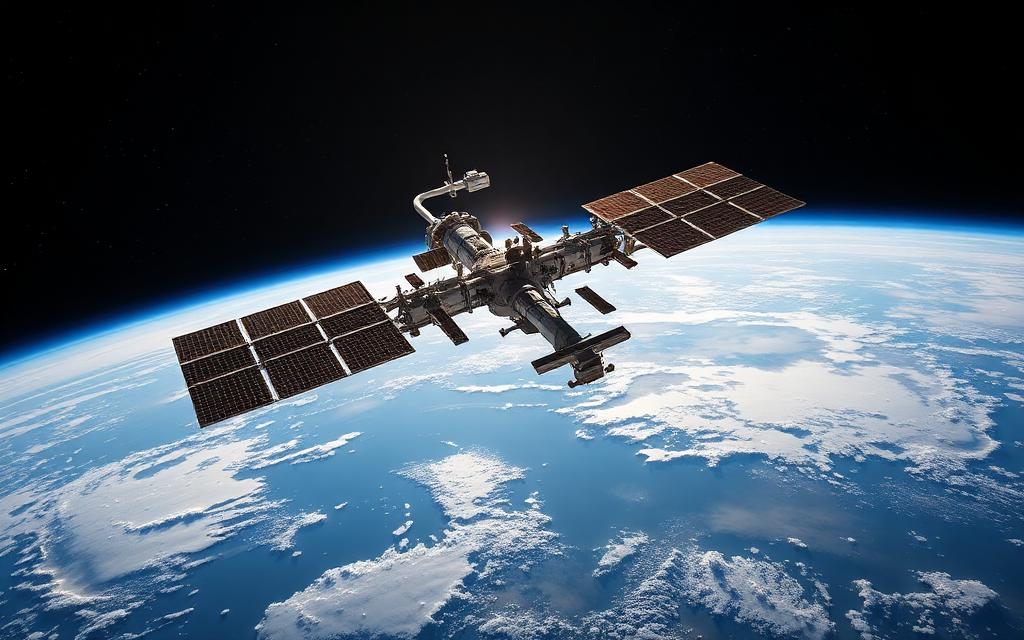
A satellite is any object that orbits a larger body. The Moon is Earth's natural satellite, but when most people say "satellite" they mean an artificial spacecraftdeliberately placed in orbit to perform a job — relaying TV signals, taking pictures of weather systems, or carrying astronauts. There are now more than 8,000 active satellites in orbit, and that number is growing fast thanks to mega-constellations like Starlink.
Why Satellites Don't Fall Down
The most common question about satellites is also the most important: if gravity pulls everything toward Earth, why doesn't a satellite fall? The short answer is that it is falling — constantly. But it's also moving sideways so fast that the curve of its fall matches the curve of the Earth. The satellite keeps "missing" the ground.
Isaac Newton imagined this with a thought experiment: fire a cannon from a tall mountain. At low speed the cannonball lands nearby. Faster, it lands further away. Fast enough — about 7.8 km/s in low orbit — and the ground falls away beneath it just as quickly as the ball falls toward it. That's an orbit. Read the orbital mechanics guide for the math.
The Anatomy of a Satellite
Almost every satellite, from a shoebox-sized CubeSat to the bus-sized Hubble, contains the same core subsystems:
- Bus / structure — the chassis that holds everything together.
- Power — solar panels and rechargeable batteries (lithium-ion is now standard).
- Thermal control — radiators, heaters and multilayer insulation to survive +120 °C in sunlight and −150 °C in shadow.
- Attitude control — reaction wheels, magnetic torquers and star trackers that keep the satellite pointed correctly.
- Propulsion — chemical or electric thrusters used for orbit raises and station-keeping.
- Payload — the actual instruments: cameras, radio transponders, scientific sensors.
- Communications — antennas and transceivers that talk to ground stations or other satellites.
Types of Orbits
Where a satellite orbits depends on the job it does:
- Low Earth Orbit (LEO) — 200 to 2,000 km. Used by the ISS, Earth-observation satellites and Starlink. Short latency, easy to reach, but limited footprint.
- Medium Earth Orbit (MEO) — 2,000 to 35,786 km. Home to GPS, Galileo and GLONASS navigation satellites.
- Geostationary Orbit (GEO) — exactly 35,786 km above the equator. The satellite circles Earth in 24 hours, so it appears to hover above one spot — perfect for TV broadcast and continuous weather monitoring.
- Highly Elliptical Orbit (HEO) — long, looping orbits used for high-latitude communications and spy satellites.
What Satellites Do
The world runs on satellite services, often invisibly:
- Communications — TV, internet, military and emergency comms.
- Navigation — GPS in your phone, ships, planes, autonomous vehicles.
- Earth observation — weather, climate, agriculture, disaster response, defense.
- Science — telescopes like Hubble and JWST that see what no ground instrument can.
- Human spaceflight — the ISS and (soon) commercial space stations.
From Launch to Decommission
A satellite begins life on a rocket — typically a Falcon 9, Atlas V, Ariane 6 or Long March booster. The rocket places it in a transfer orbit; the satellite's own thrusters then circularize the orbit and adjust inclination. Most spacecraft operate for 5–15 years before running out of station-keeping fuel. End-of-life options are either a controlled re-entry and burn-up over the Pacific Ocean, or a boost into a "graveyard orbit" above the active belt.
Try It Yourself
The best way to internalize what you've just read is to watch real satellites move. Open the live satellite tracker and watch the ISS sweep across the globe in 90 minutes. Then jump to satellite communications to learn how those spacecraft actually talk to the ground.